Where Will Your 2027 Charter Start? Split, Athens, Palma, Naples and Bodrum Compared
Split, Athens, Palma, Naples and Bodrum compared on flights, fleet depth, first-night logistics and the cruising grounds each home port unlocks.
Leggi di più
Updated May 2026.
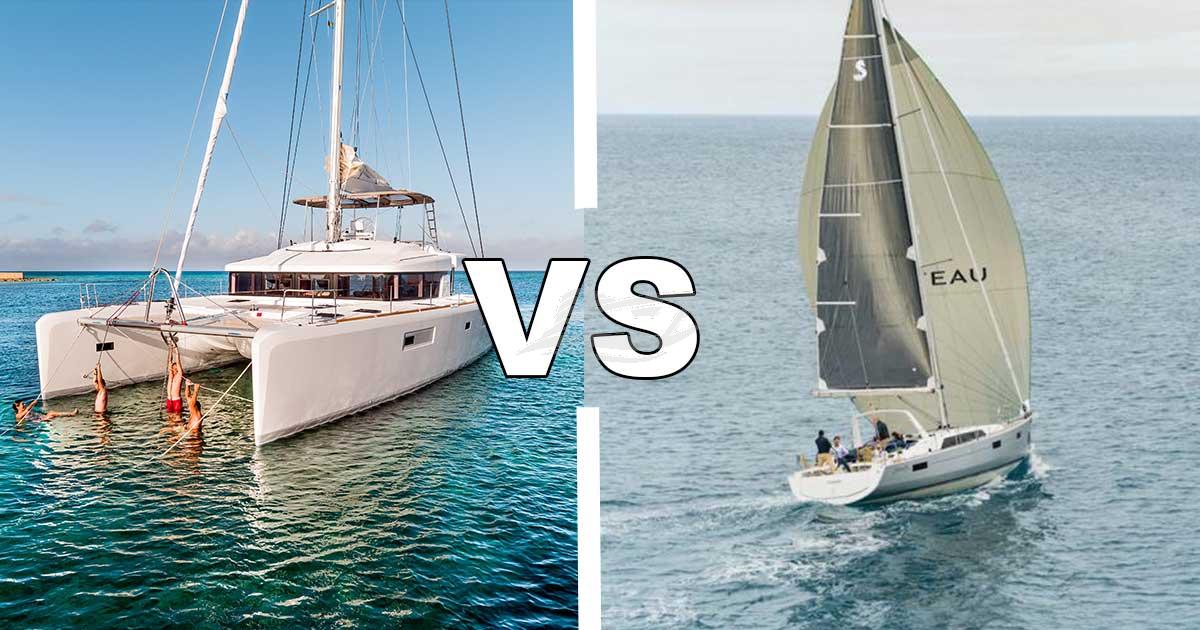
This is the honest catamaran vs monohull charter 2026 comparison from the operator side — not a sales pitch for either format. Catamarans dominate the Mediterranean and Caribbean charter fleets today for solid reasons, but monohulls remain the better choice for several specific charter profiles. This piece walks through space, sailing feel, cost, marina logistics, family fit, and the use-cases where each format wins.
Pick a catamaran if you have 6+ guests, you want space and zero heel, you have kids on board, you plan to live mostly at anchor with restaurant tenders, or you have at least one guest who gets seasick on a heeled monohull. Pick a monohull if budget per cabin matters more than space, you want classic sailing feel and upwind performance, your group is 4 or fewer, or your itinerary needs to fit into tight marina berths regularly.
A 47 ft cruising catamaran has roughly the same interior space as a 60 ft monohull. The saloon, cockpit and galley are typically 60-80% larger than the equivalent-length monohull. Cabins on a catamaran sit in the hulls — one cabin per hull-end — with the master often in a separate hull from the rest. Privacy across cabins is dramatically better than on a monohull, where cabins share bulkheads down the centreline.
For a group of six adults, the catamaran’s space advantage is the single most-cited reason for the choice in our bookings. Two couples plus a third on a catamaran feel like they have their own zones. The same group on a 47 ft monohull will be much closer.
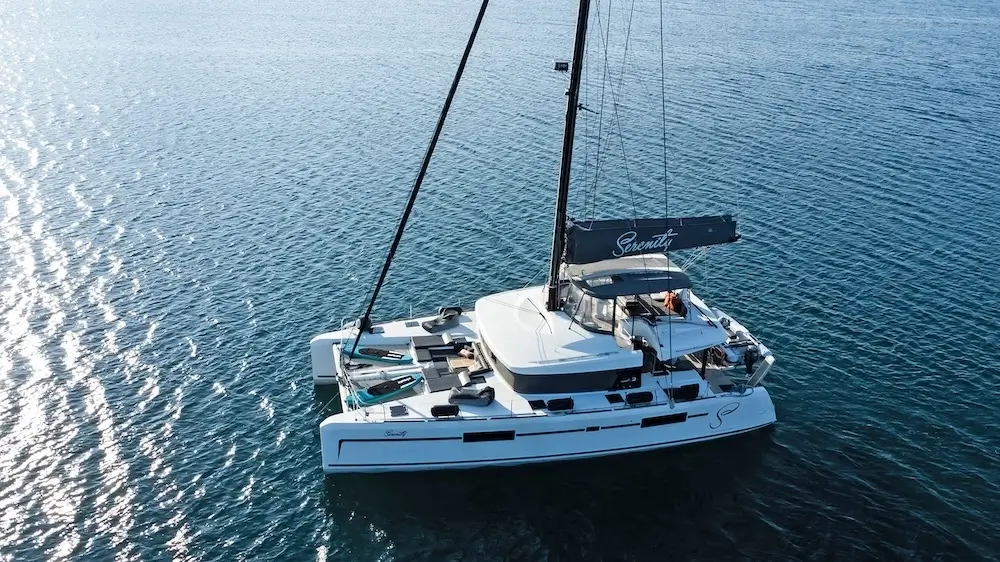
Monohulls heel. That heel is what most lifelong sailors call “sailing”. A 50 ft monohull in 18 knots of wind leans 15-20 degrees, accelerates through the gusts, and carves through chop. A catamaran in the same conditions stays flat, makes a similar speed (typically 1-2 knots slower) but feels physically different — less “in” the wind, more “on top of” the water.
For a charter group with a strong sailor at the helm who wants the boat to respond, the monohull is the better answer. For everyone else — first-time charterers, mixed-ability groups, families — the flat platform of a catamaran is the more comfortable choice on a 7-day week.
Upwind: the monohull wins clearly. A modern 50 ft cruising monohull points 35-40 degrees off the wind; a cruising catamaran points 50-60 degrees. On an upwind itinerary leg, the monohull saves real time.

Catamaran charters cost 30-50% more per week than equivalent-length monohulls. A 47 ft catamaran in Croatian high season runs €9,000-12,500 per week; a 47 ft monohull in the same week runs €5,500-8,000. The numbers move similarly in Greece and the Caribbean.
Per-cabin, the gap narrows. A 47 ft monohull sleeps 6-7 in three cabins; a 47 ft catamaran sleeps 8-10 in four cabins. Per-cabin cost on the catamaran is €2,250-3,100 per week; on the monohull, €1,830-2,660 per week. Closer but the monohull still wins per cabin.
Marina costs: the catamaran pays 1.7-2× the monohull berth fee at most Croatian and Greek marinas (ACI, Olympia, etc.) because beam is the billing unit. Over a week with three marina nights, that adds €150-300 to the catamaran total.

Catamaran beam ranges from 7.5 metres (Lagoon 42, Bali 4.2) to 9.5+ metres (performance cats, Bali 5.4, Lagoon 55). Several Croatian and Greek marina berths are sized for monohulls and cannot accept catamarans wider than 8 metres. The practical impact: a catamaran charter needs marina pre-bookings at every overnight harbour stop, while a monohull can usually walk in.
For the Amalfi Coast, the Cyclades, and the Croatian peak-season weekend at Hvar town quay — all marinas where berths fill up early — the monohull’s wider berth availability is an underrated advantage. The catamaran needs better planning.
For families with children under 14, the catamaran wins on every metric. No heel means no seasickness during meals, no falling out of bunks at night, no “hold on while we tack”. Bow trampolines double as a kid play space at anchor. Cabin separation lets parents and kids sleep on opposite ends of the boat. Swim platforms are flat, low, easy entry/exit for kids 4+.
The monohull is workable for families with experienced sailing kids 10+ who treat the heel as part of the adventure, but for the typical family week, the catamaran is the format-of-default reason number one.

Two couples on a 42-45 ft monohull is the classic sailing-week format. Three cabins (one as the lockers/lazarette), good sailing performance, low cost, and a tight-knit group dynamic. The same couples on a 42 ft catamaran will feel they paid €3,500-5,000 extra for space they did not need. For the two-couple charter, monohull is usually the value pick.
Above six guests the math flips. A 50 ft monohull sleeps 8 in four cabins, but the saloon, cockpit, and galley start to feel cramped at meal times. The same eight guests on a 47 ft catamaran spread comfortably across two hulls and a wide cockpit. For corporate groups, extended families, or three-couple weeks, the catamaran is the answer.
The catamaran category itself splits. Cruising catamarans (Lagoon, Bali, Leopard) are designed for comfort and space, with modest sailing performance. Performance catamarans (Outremer, Catana, Fountaine Pajot Saona) sail closer to the wind and faster but trade some interior volume. For a charter week where sailing performance matters, the performance cat is the choice; for the typical relaxed Mediterranean week, the cruising cat delivers the better deck-to-saloon flow.

— Family with kids 4-14: catamaran
— Two couples, sailing-focused week: monohull
— Six+ adults, social week: catamaran
— Single couple, romantic week: monohull (better intimacy)
— Corporate / team retreat (8-10 guests): catamaran
— Upwind-heavy itinerary (Cyclades against the Meltemi): monohull
— Mixed ability, first-time charter: catamaran
— Budget-constrained week, 4 guests: monohull.
Both are safe charter platforms. The catamaran is more stable at anchor and harder to capsize in normal conditions but performs differently in heavy weather (less self-righting). For the typical charter week in normal Mediterranean weather, the safety difference is not a practical decision factor.
Yes — many first-time skippers learn on a 38-42 ft monohull during a one-week charter with a flotilla or skipper. Catamarans are easier to handle but the muscle memory transfers less directly to other boats.
Either works. Catamaran wins for shore-side restaurant runs (shallow draft) and group comfort. Monohull wins for marina flexibility and budget. The Croatian charter mix today is roughly 60% monohull, 40% catamaran by booking count.
Power cats (Aquila, Lagoon Sixty 7) are the third option — same flat-platform comfort, no sail handling, faster between anchorages. Cost is higher than sail cats by 20-40%. Right for groups that want the catamaran feel without the sailing element.
On a crewed charter the deck operations disappear from the guest experience. The space-versus-feel decision still applies but the sailing-handling argument for monohulls weakens. Crewed charters tilt toward catamarans for group comfort.
Compare further with how much it costs to charter a yacht or types of yachts available in Croatia and Greece.