Croatia or Italy for Your 2027 Charter? Value Coast vs Glamour Coast
Croatia vs Italy for your 2027 charter: short hops and value against Amalfi glamour and 22% VAT, with real cost deltas.
Read more
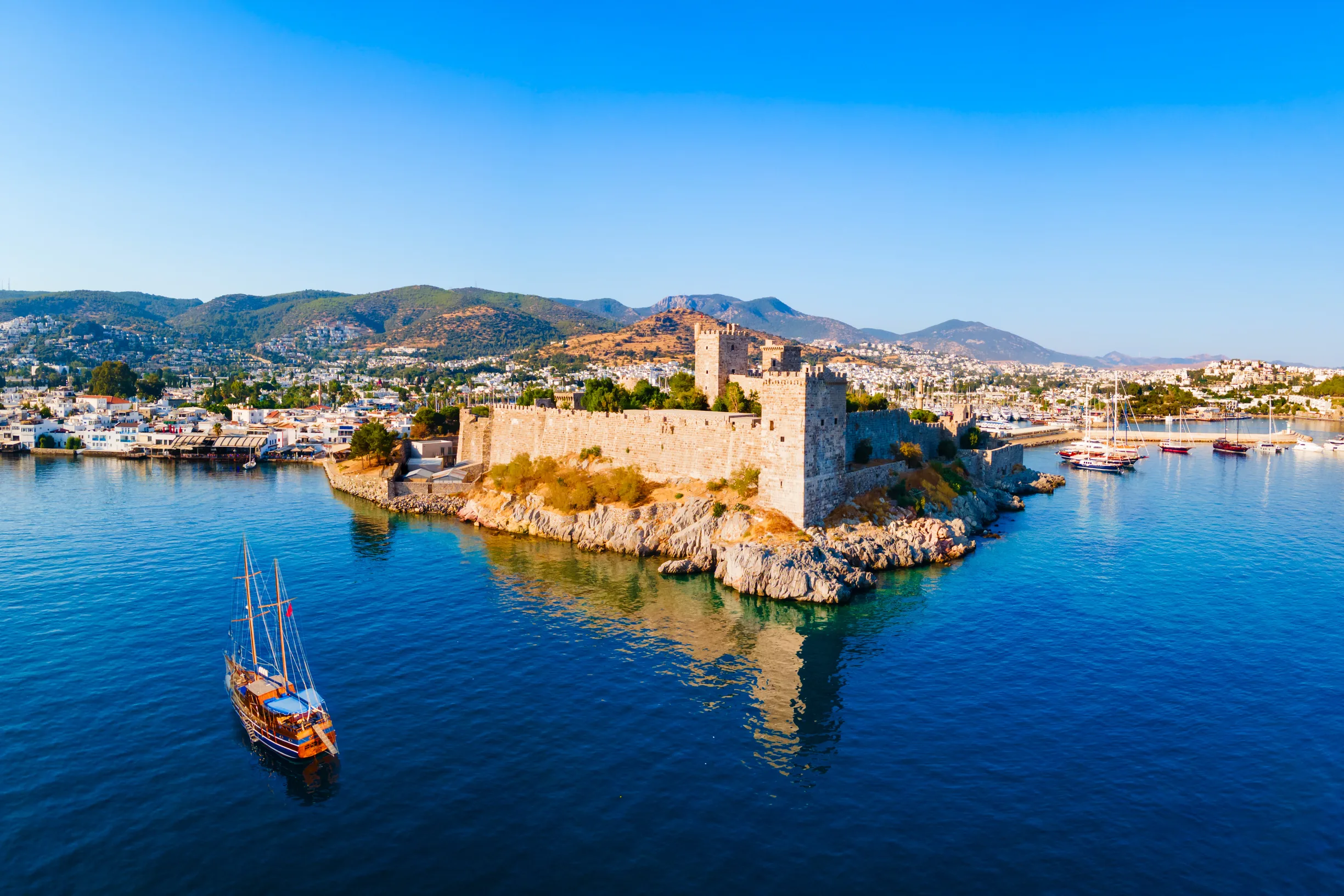
On the Turkish coast the boat question splits along an unusual line. Almost every gulet you can charter comes with a crew as standard, while catamarans are usually offered bareboat or with a hired skipper. So the gulet vs catamaran charter decision is really two decisions in one: what kind of boat you want under you, and how much you want to do yourself.
We charter both regularly out of Bodrum, Göcek and Fethiye, and the right answer depends almost entirely on your group size, your sailing appetite and how you feel about being looked after. Here is the per-person maths and the honest case for each.
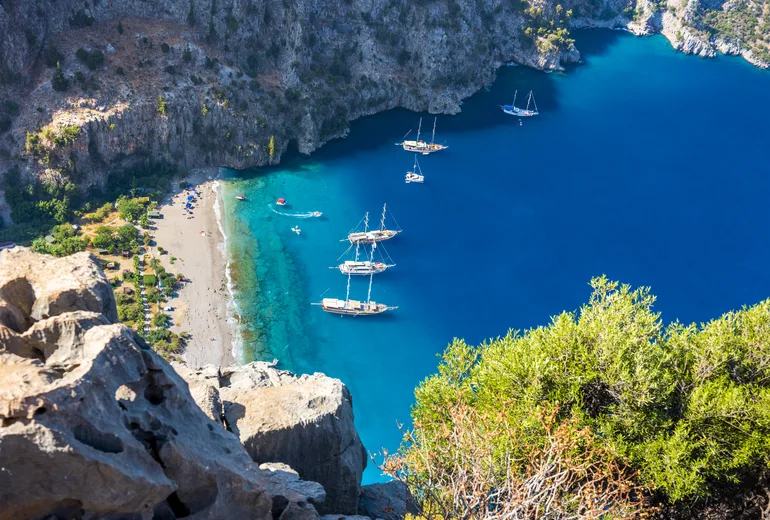
A gulet is a broad-beamed wooden motor-sailer, traditionally built in Bodrum and Marmaris, ranging from about 18 to 40 metres. Most carry six to sixteen guests in en-suite cabins, and crucially they sail with a captain, a deckhand and a cook included. You step aboard, someone hands you a plate of menemen, and the itinerary along the Lycian coast more or less runs itself.
This crewed-by-default model is why a gulet feels less like sailing and more like a small floating hotel that happens to move between bays. The engines do most of the work; the sails go up when the wind and the captain agree. If that sounds appealing rather than disappointing, the gulet is probably your boat.
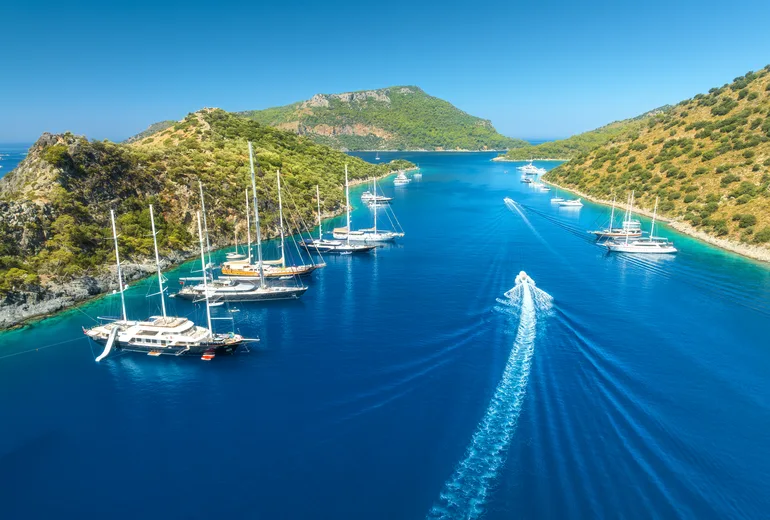
A charter catamaran — a Lagoon, Bali or Fountaine Pajot in the 40 to 50-foot range — trades the wooden charm and the cook for sailing performance, shallower draft and far more anchoring freedom. You can creep into the Yassıca islets off Göcek or tuck behind a reef where a deep-keeled boat would not dare, and the boat genuinely sails.
The catch is responsibility. Bareboat means you skipper it yourself, which requires a recognised licence and a confident crew. Most groups who want the cat experience without the workload hire a professional skipper for around €180–230 a day, and then split provisioning and cooking among themselves. If you are still deciding on hull type in general, our broader guide to choosing a catamaran or a monohull covers the trade-offs beyond Türkiye.
This is where the comparison gets concrete, and where group size changes everything.
A standard-class gulet for eight to twelve guests in peak season typically runs €1,000–1,800 per cabin per week, all crew included, with food and fuel either bundled or charged as a transparent “APA”-style kitty of roughly €150–250 per person for the week. Luxury gulets climb well beyond that. For a full boat of twelve, the crewed, fed, fuelled total often works out around €1,500–2,200 per person.
A 46-foot catamaran sleeping eight comfortably runs roughly €7,000–11,000 a week bareboat in high season. Add a skipper (€1,300–1,600 for the week), fuel (€300–500), a berth or two, and your own provisioning, and a full boat of eight lands somewhere around €1,300–1,900 per person — with the cooking on you.
So the per-person figures are closer than people expect. The gulet is not automatically the expensive choice, and the catamaran is not automatically the budget one. The cook and full crew on the gulet are doing a lot of quiet work that would otherwise eat into your “saving.”
Two things make this comparison different from the same question in Greece or Croatia.
The classic Turkish “blue cruise” — the lazy, motor-assisted amble between Lycian bays with a cook aboard — was built around gulets. It is a genuine local institution, not a tourist invention, and the gulet captains know every sheltered cove from Göcek to Kekova. If that idleness is the holiday you are picturing, our explainer on what a blue cruise on the Turquoise Coast involves is worth reading first.
The most beautiful spots — the Göcek twelve islands, Butterfly Valley, the Kekova sunken city — get busy in July and August. Gulets tend to raft up together in the popular bays; catamarans can slip into shallower, quieter corners. If beating the crowds matters to you, the cat’s flexibility is a real advantage.
Both boats are stable, but in different ways. A gulet’s sheer mass and broad hull make it feel planted at anchor, and the shaded aft deck — usually with a long table and a mountain of cushions — becomes the centre of the trip. Meals appear, the engine hums, and the whole rhythm is gentle. For anyone prone to seasickness or travelling with elderly relatives, that steadiness is worth a lot.
A catamaran rides flatter under sail than a monohull and gives you two hulls’ worth of cabins plus a trampoline up front, which kids and sun-seekers love. The trade-off is that you are running the show: someone cooks, someone does the morning briefing, someone takes the helm. Many crews enjoy that involvement; it is part of why a sailing-led week feels more like an achievement than a service. Think honestly about which version your group actually wants before you put down a deposit.
On a gulet the cook handles breakfast and usually lunch and dinner too, shopping en route at quayside markets in Göcek or Marmaris. On a catamaran you provision yourself — a big supermarket run before departure, then top-ups in harbour towns. Eating ashore is easy in both cases: the waterfront restaurants in Fethiye, Kaş and Bozburun are excellent and reasonably priced by Mediterranean standards.
You are a larger group (eight-plus), you have mixed mobility or non-sailors aboard, you want meals handled and decisions minimal, and the appeal is reclining on deck cushions while the coast slides past. Multi-generational family trips and milestone-birthday groups almost always land here, and rightly so.
You are a smaller, more active group, at least one of you sails (or you are happy to hire a skipper), and you want to actually steer, anchor where you like and feel the boat move. Couples doubling up and sailing-curious friends usually have more fun on the cat. The question of whether to take crew at all is one we unpack in do you need a yacht charter crew or not.
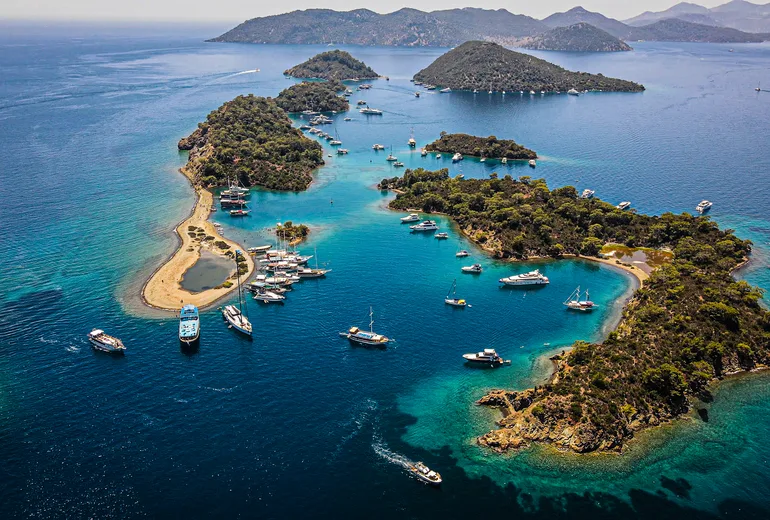
From Bodrum, a gulet drifts comfortably toward the Gulf of Gökova — Cleopatra’s Island, English Harbour, the warm sulphur springs — without anyone touching a winch. From Göcek or Fethiye, a catamaran can build a tighter, sailing-led loop through the twelve islands, Tersane and across toward Ölüdeniz, covering more ground under sail. Both areas are short on long open passages and long on protected water, which is part of why Türkiye is such a kind place to learn.
If you are weighing Türkiye against its neighbours on price as well as boat type, our 2027 price comparison of Türkiye, Greece and Croatia puts the numbers side by side, and our overview of the main European charter home ports including Bodrum explains where each base makes sense.
Not necessarily. When you account for the included crew, cook and meals on a gulet, per-person costs often land within a few hundred euros of a skippered catamaran. The gulet bundles services the cat charter leaves to you.
No. Gulets are fully crewed, so no licence or sailing experience is required from guests. A bareboat catamaran does require a recognised certificate; a skippered catamaran does not, since the hired skipper carries the qualification.
Usually a gulet. The wide, stable deck, en-suite cabins, on-board cook and full crew make it the easier choice for mixed ages and mixed mobility. A catamaran is stable too, but you carry more of the daily workload.
Yes. A catamaran’s shallow draft lets it anchor in coves and behind reefs where larger gulets cannot go, which helps in the busier July–August stretch around Göcek and Fethiye.
Not sure which hull fits your group? Tell us your numbers and dates and we will price a gulet and a catamaran against each other, or browse the Turkish charter fleet to see what is available for your week.