Yacht Charter Europe from Australia: How to Combine Two or Three Sailing Weeks in One Trip
By Europe Yachts Charter
·18 min read
The best yacht charter Europe from Australia is usually two charters, not one. After 24 hours or more in the air, very few Australian crews fly to the Mediterranean for a single week on the water. They come for three to five weeks, and the smart way to spend that time is to anchor the whole trip around one or two Saturday-to-Saturday charters in different countries, with land days in between.
Below: open-jaw flights, the Schengen 90-day rule and the two coastlines outside it, the order that makes jet lag easier, sailing pairings that fit together, licences by country, and weekly costs in euro and Australian dollars.
Why a yacht charter Europe from Australia is rarely just one week
The maths of the long haul decides it. A return economy fare from Sydney or Melbourne to southern Europe in July costs much the same for a ten-day stay as for a thirty-day one, and the first two days after landing are half lost to the body clock anyway. Most of the Australian guests we plan trips for take four weeks of annual leave, sometimes stretched with long service leave, and want the Mediterranean to feel like more than a quick swim between airports.
In practice the trip falls into a simple shape. Arrive, rest two nights on land, sail a week, spend three or four days travelling to the next coast, sail a second week, then finish with a city before the flight home. One charter suits a three-week trip; two charters suit four or five. Three charters back to back sounds tempting and usually ends with a tired crew who stop noticing the anchorages by week three.
Open-jaw flights: land in one country, fly home from another
There are no non-stop flights between Australia and Croatia or Greece. The workable routes have one stop: Qatar Airways through Doha, Emirates through Dubai, Etihad through Abu Dhabi, Singapore Airlines through Singapore or Turkish Airlines through Istanbul. From Sydney or Melbourne plan on roughly 21 to 27 hours door to door to Athens, and 24 to 30 hours to Split. Perth travellers have one more option: Qantas has flown a seasonal non-stop to Rome in recent northern summers, so check whether it is running for your dates.
For a two-country trip, book an open-jaw ticket, also called multi-city: fly into one city and home from another. Into Athens and out of Rome works for a Greek week followed by Italy. Into Split and out of Palma works for Croatia followed by the Balearics. With the Gulf carriers an open-jaw often prices close to a simple return, and it saves you a backtracking flight of four or five hours.
Land at least a day before the first charter, since a missed connection in Doha will not hold a boat for you, and keep a buffer night before the flight home.
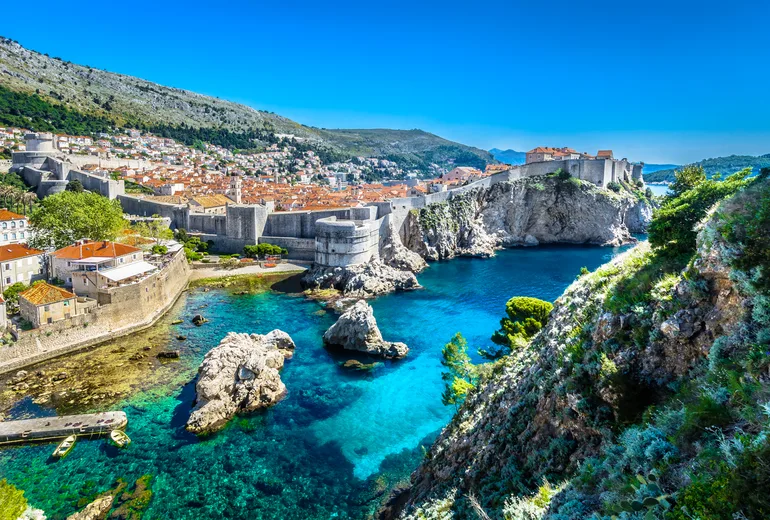
Dubrovnik, the hinge between a one-way Croatian week and the Bay of Kotor in Montenegro.
The Schengen budget, and the two coastlines that sit outside it
Australian passport holders travel visa-free in the Schengen area for 90 days in any rolling 180-day period. Croatia, Greece, Italy, Spain and France are all inside it, and the days add up across countries, so a week in Rome counts against the same total as a week in Hvar. On a four or five-week trip that only bites if you were in Europe earlier in the window or plan a long stopover on the way home.
This is where the two non-Schengen sailing areas earn their place. Montenegro is not in Schengen, and Australians can stay there visa-free for up to 90 days, counted separately. Türkiye is also outside Schengen. Australians used to need an e-Visa for Türkiye, but since April 2026 Australian ordinary passport holders have been allowed in visa-free for tourism stays of up to 90 days in 180. Rules like this change, so confirm both countries on Smartraveller a month or two before you fly.
The EU’s ETIAS authorisation was still not in force in late 2026, so check before you fly, and if the route passes through London, Australians now need a UK Electronic Travel Authorisation. When a yacht crosses from Croatia into Montenegro, the skipper clears out and in at official ports of entry with the crew list and passports.
The time-zone ladder: start east, finish west
In the northern summer Greece and Türkiye are seven hours behind Sydney, Melbourne and Brisbane, and five behind Perth. Croatia, Montenegro, Italy, France and Spain are eight hours behind the east coast and six behind Perth. That one-hour step is useful. A route that starts in the east, say Athens or Dalaman, and works west towards Croatia, Italy or the Balearics lets the body adjust to the biggest jump first and then take a smaller one a fortnight later.
There is a quirk for late-season trips. Once New South Wales, Victoria and the ACT move to daylight saving on the first Sunday of October, Palma and Split sit nine hours behind Sydney, while Brisbane stays at eight.
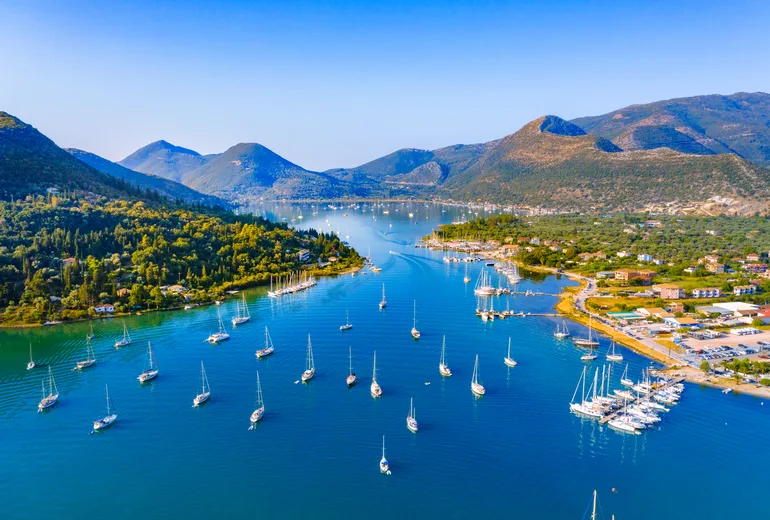
Nydri on Lefkada, a common Ionian start and seven hours behind Sydney in summer.
Four pairings that work for Australian crews
Croatia and Montenegro, one way
Sail one-way from Split to Dubrovnik through Hvar, Vis, Korčula and Mljet, then continue by road or by boat into the Bay of Kotor. Dubrovnik to Tivat is roughly 35 to 40 nautical miles, a long day under sail, and not every operator allows the crossing, so ask early; one-way and border fees are quoted per boat. The Bay of Kotor rewards the effort: Perast, Kotor’s walled old town, Njeguši pršut and a glass of Vranac. Our sister site’s guide for Australians sailing Croatia by catamaran covers the Croatian half in detail.
Greece’s Ionian and Türkiye’s Lycian coast
A gentle first week in the Ionian, from Lefkada to Meganisi, Kioni on Ithaca and Fiskardo on Kefalonia, with short legs of 8 to 15 nautical miles and an afternoon breeze that usually settles by evening. Then a travel day through Athens or Istanbul to Dalaman, and a crewed second week out of Göcek or Fethiye: the Twelve Islands, the lagoon at Ölüdeniz and on towards Kaş and the sunken ruins at Kekova. Our Ionian yacht charter guide has the island-by-island detail for the Greek week.
Amalfi Coast and Sardinia
Italy splits neatly into two different seas. A week from Naples or Salerno takes in Procida, Capri, Positano and Amalfi, with limoncello, scialatielli with seafood and harbour fees that make a skipper who knows the moorings worth having. A short domestic flight or the overnight ferry from Civitavecchia brings you to Olbia for a second week around the La Maddalena archipelago and Tavolara, with Vermentino di Gallura in the glass and Bonifacio in Corsica about ten miles across the strait.
The Balearics as a late-season add-on
Mallorca, Menorca, Ibiza and Formentera hold their warmth well into autumn, with sea temperatures typically around 24°C in late September. That makes Palma a good second charter after an early-September week elsewhere, and the open-jaw home from Palma closes the loop. A Palma week can take in Cabrera’s national park (mooring buoys there need a permit booked ahead), Porto Colom and the crossing of about 25 nautical miles to Menorca’s south coast.
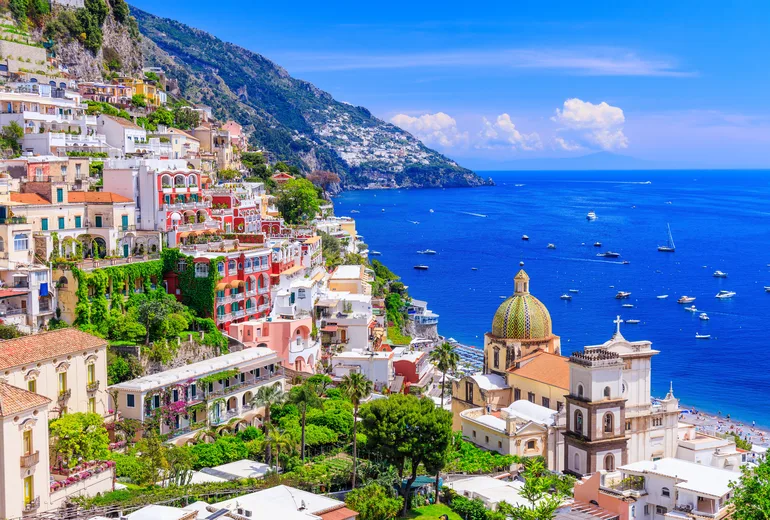
Positano on the Amalfi Coast, the first half of an Italian pairing with Sardinia.
Gulets for three generations on one deck
When the crew is grandparents, parents and children together, a gulet often solves more problems than any other boat. These wooden motorsailers, 20 to 35 metres long, come with their crew by definition: there is no bareboat gulet. The captain, a cook and one or two deckhands handle anchoring, meals and the tender, which leaves the adults free and keeps a deckhand watching the swimmers. Cabins usually have their own bathroom, and the wide shaded aft deck is where three generations end up eating together at a long table.
Türkiye is the home of the gulet, with the classic blue cruise routes out of Bodrum, Göcek and Marmaris, and Croatia has a large gulet fleet around Split and Dubrovnik. On the Turkish coast, village women still row out to some bays in Göcek selling gözleme, and lunch on board tends to be a spread of meze, grilled sea bass and salads. For ideas on keeping children of different ages busy afloat, see our family yacht charter guide to Mediterranean destinations for kids.
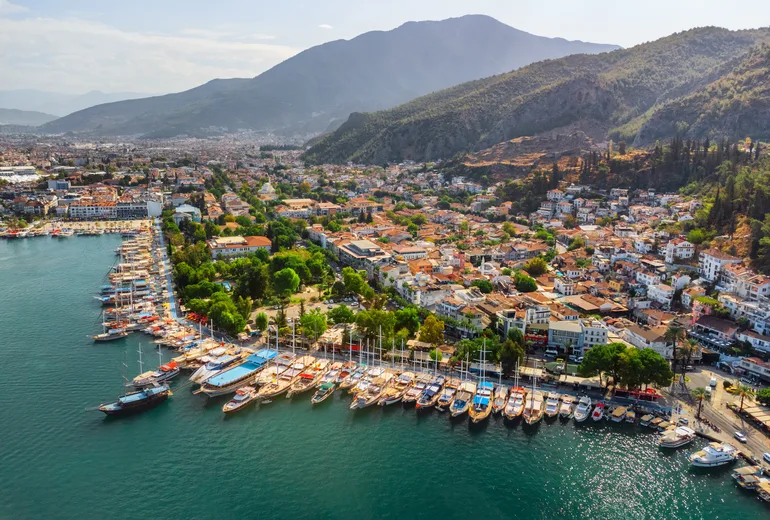
Gulets on the quay at Fethiye, a base for crewed weeks along the Lycian coast.
Licences at a glance: what an Australian skipper can sail where
For a bareboat, here is how an Australian licence travels:
Croatia: recognises five Australian state licences for bareboat yachts up to 30 gross tonnes: the NSW General Boat Driving Licence, Queensland Marine Licence Verification Certificate, South Australian Boat Operator’s Licence, WA Recreational Skipper’s Ticket and Victorian Marine Licence (not the restricted version). You also need a separate VHF radio certificate.
Greece: an ICC or RYA Day Skipper is the reliable route. Australian state licences are not consistently accepted, and many operators also ask for a second crew member with sailing experience.
Italy, Spain, Türkiye and Montenegro: an ICC or an equivalent recognised certificate, plus a VHF certificate, is what operators generally expect. Requirements vary by boat size and operator, so confirm in writing before booking.
Every operator also checks experience, usually with a short sailing CV. If your paperwork does not fit, a skipper solves it for roughly €1,400 to €1,750 a week, or A$2,240 to A$2,800, plus the skipper’s meals. Our post on the International Certificate of Competence for Australians explains how that certificate fits with an Australian licence.
When to book and what each yacht type costs in AUD
For July and August, book the boats 9 to 12 months ahead, which for a 2027 trip means now. Four-cabin catamarans and family-sized gulets go first. June and September give a little more room, typically six to nine months. Fix the charter dates first, then the flights. More on deposits and timing is in how far in advance to book a yacht for a summer trip.
Prices here are in euro, converted at about A$1.60 to the euro as of early November 2026. The rate will move; the euro base price will not. Typical weekly hire for the boat:
Sailing yacht, 40 to 46 feet, bareboat: €2,000 to €4,500 in June or September (A$3,200 to A$7,200), €3,500 to €7,000 in July and August (A$5,600 to A$11,200).
Catamaran, 40 to 45 feet, bareboat: €4,000 to €8,000 in shoulder weeks (A$6,400 to A$12,800), €7,000 to €14,000 in peak (A$11,200 to A$22,400).
Crewed gulet for 8 to 12 guests in Türkiye: roughly €9,000 to €20,000 a week (A$14,400 to A$32,000) depending on size and month, with food and drinks often charged on top. Larger Croatian gulets in August run higher.
Motor yacht: from about €12,000 to €25,000 for a 15 to 18-metre boat with skipper (A$19,200 to A$40,000), and €35,000 to €70,000 or more for a fully crewed 25-metre yacht in peak (A$56,000 to A$112,000), plus an advance provisioning allowance of 25 to 35 percent.
On top of the charter fee, allow for fuel, marina nights, provisioning, tourist tax and any one-way fee. Our breakdown of how much it costs to charter a yacht lists those extras line by line.
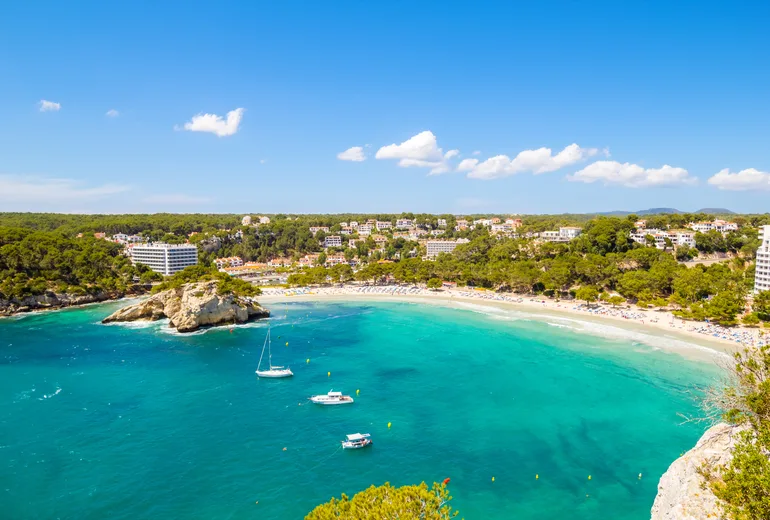
Cala Galdana on Menorca's south coast, a late-September stop on a Palma charter.
A sample four-week trip: Split in, Palma out
A September plan for a family or two couples, outside the July school holidays, using about 25 days of the Schengen budget.
Days 1 to 3: fly into Split through Doha or Dubai, arriving Thursday. Two nights in Trogir or Split to sleep off the eight hours.
Days 3 to 10: board a catamaran on Saturday afternoon for a one-way week to Dubrovnik: Šolta, Hvar and the Pakleni islands, Vis, Korčula and Mljet’s lakes at Pomena. Peka and Plavac Mali at a konoba most nights.
Days 10 to 13: a day inside Dubrovnik’s walls, then road transfer to the Bay of Kotor for three nights in Perast or Kotor, outside Schengen.
Days 14 to 17: back to Dubrovnik airport and on to Palma through a European hub, about half a day. Two nights in Palma’s old town or Sóller, with ensaïmada for breakfast.
Days 17 to 24: board a skippered sailing yacht or catamaran in Palma on Saturday for Cabrera, Cala d’Or, Porto Colom, then across to Menorca’s Cala Galdana and Ciutadella. Mahón cheese and sobrassada for the provisioning.
Days 24 to 28: a buffer in Barcelona or back in Palma, then the open-jaw flight home.
Swap the second half for a gulet week out of Göcek and the plan becomes Split in, Dalaman or Istanbul out, with even fewer Schengen days.
Frequently Asked Questions
How many weeks should Australians plan for a Mediterranean sailing trip?
Three weeks fits one charter with rest days either side; four to five weeks fits two charters in different countries.
Do days in Montenegro and Türkiye count towards the Schengen 90 days?
No. Both countries sit outside the Schengen area, so days there are counted separately. Australians can visit Montenegro visa-free for up to 90 days, and since April 2026 Türkiye has also admitted Australian tourists without a visa; confirm both on Smartraveller before you travel.
Can I use my Australian boat licence to rent a bareboat in Europe?
In Croatia, five Australian state licences are officially recognised for yachts up to 30 GT, together with a VHF certificate. In Greece, Italy, Spain and Türkiye an ICC or RYA Day Skipper is the safer route, so confirm in writing with the operator or book a skipper.
What is an open-jaw ticket and is it more expensive?
It is a ticket that flies into one city and home from another, for example into Athens and out of Rome. It often costs close to a standard return and saves a backtracking flight.
Is a gulet a good choice for a family with grandparents and young children?
Often the best one. A gulet comes with its own captain, cook and deckhands, cabins usually have private bathrooms, and the shaded aft deck gives everyone space.
How far ahead should I book a yacht charter in Europe from Australia?
For July and August, 9 to 12 months ahead. For June or September, six to nine months is usually enough, though family-sized catamarans and gulets still fill early.
You can read more about how we protect your personal data and use cookies in our Privacy Policy.
With your consent, we and Google use cookies and similar technologies to store and access information on your device and to process personal data such as your visit to this website, your IP address and cookie identifiers. You can withdraw your consent at any time through “Cookies Settings” at the bottom of every page.
We and Google process data for:
Website analytics and visit statistics, recordings of visits to improve the website, ad measurement and remarketing, storing and accessing information on your device

 Charter Tips