Yacht Charter Europe from the USA: Which Country to Pick for Your First Mediterranean Charter
By Europe Yachts Charter
·17 min read
For most Americans planning a first yacht charter Europe from the USA, the choice comes down to five coastlines: Croatia, Greece, Italy, Spain’s Balearic Islands and Türkiye. Croatia is usually the easiest start for an East Coast crew that wants to skipper itself, because the nonstop flights land a short taxi ride from the marinas. Greece wins on variety, Italy on food and glamour, the Balearics on beaches and late warmth, and Türkiye on the value of a fully crewed gulet.
This guide sorts them the way an American vacation really works: ten to fourteen days off, one long flight each way, and a crew that may or may not include someone with an ASA 104 in their wallet. Below are the flights, how a US certificate is treated in each country, which yacht type suits the time you have, and weekly budgets in euros and dollars.
Yacht charter Europe from the USA: three questions before you pick a country
Before comparing islands, settle three things. First, who runs the boat? A crew with a bareboat-qualified skipper has the widest choice, while a group with no certificate is really choosing between a hired skipper and a fully crewed yacht, and that shifts which countries make sense. Second, how much jet lag can the group take? From New York, Croatia and Italy are six hours ahead in summer and Greece is seven; from Los Angeles or Seattle the jump is nine or ten. Third, what does a good day look like for your people: a quiet anchorage and a long swim, or a harbor town with a wine bar and a late dinner?
In practice, experienced East Coast crews lean towards Croatia, mixed family groups towards Greece, and food-first groups towards the Amalfi Coast. Our Croatia versus Greece comparison for a first charter goes deeper on the two most common finalists.
Croatia: the nonstop pick for East Coast sailors
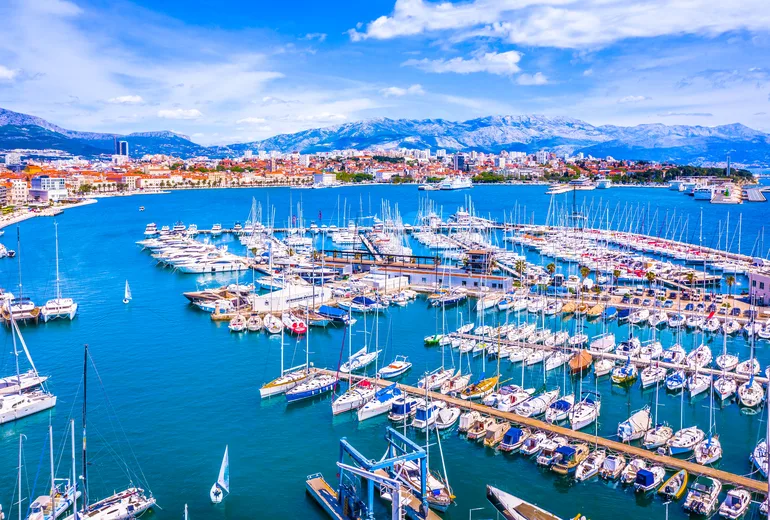
Croatia is the one Mediterranean charter country with US nonstops landing next to its biggest bases. In summer 2026 United flew Newark to Dubrovnik daily and launched Newark to Split three times a week, the only US nonstop into Split. The 2027 schedules are not published yet, so plan on the same pattern only if United repeats it. Delta has flown JFK to Dubrovnik in past summers; check whether it returns before building a trip around it.
Split opens up central Dalmatia: Šolta, Brač, Hvar and the Pakleni islands, Vis and Korčula, mostly in hops of 10 to 20 nautical miles. The maestral, a northwesterly that typically fills in after lunch at 10 to 20 knots, gives good afternoon sailing and settled evenings. Dubrovnik suits a one-way week north through Mljet, Korčula and the Pelješac peninsula, where Plavac Mali is the red to order with a slow-cooked peka. Charters run Saturday to Saturday, which lines up neatly with a Thursday or Friday overnight from Newark.
The adjustment for Americans is the mooring style. Mooring balls are scarce compared with the BVI; most nights you back stern-to onto a town quay or marina pontoon and pick up a lazy line from the bow. Our sister site’s Croatia catamaran guide for American sailors covers that technique, tipping and July 4th week availability in more detail.
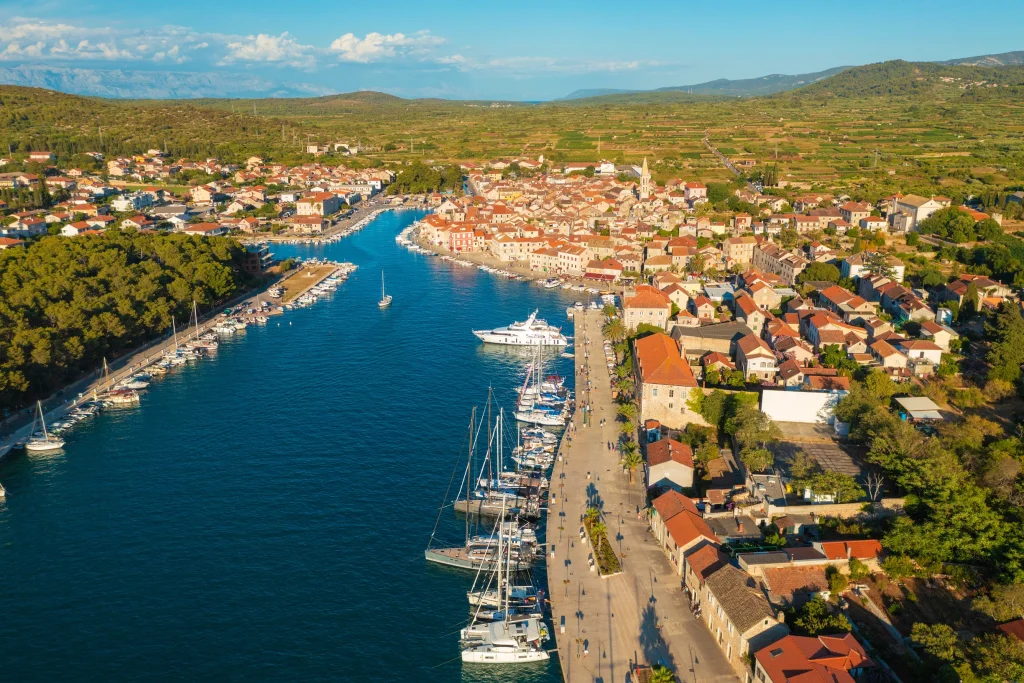
Split's marinas, a short drive from the airport that United served nonstop from Newark in 2026.
Greece: one airport, three different seas
Athens is the gateway for most Greek charters, and it is well linked to the US. Several hubs typically have summer nonstops, among them Newark, JFK, Atlanta, Boston, Philadelphia and Chicago, and American added a daily Dallas/Fort Worth service from 21 May 2026. The line-up shifts each season, so check the exact routes for your dates. The main bases at Alimos and Lavrion are roughly 40 minutes from the airport.
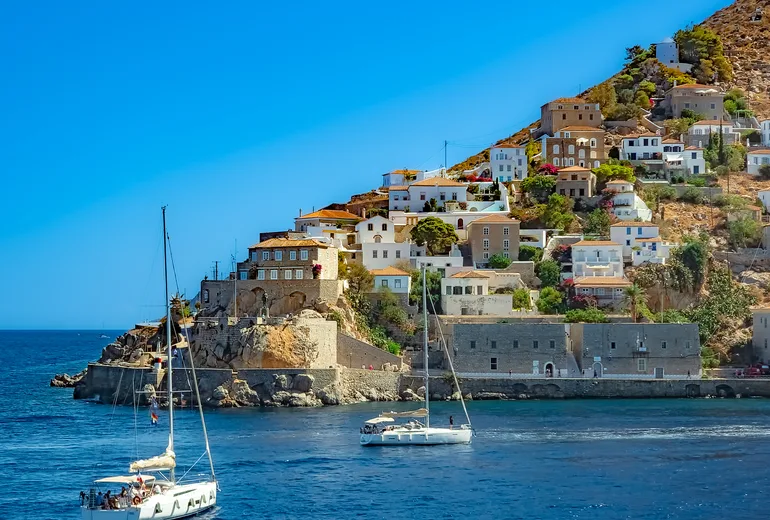
From that one airport you reach three very different sailing grounds. The Saronic Gulf, with Aegina, Poros and Hydra, offers short legs and sheltered water, a gentle first week. The Cyclades, from Kea and Kythnos out to Syros and Paros, are the Greece of the postcards, but the meltemi often blows 20 to 35 knots in July and August and asks for real experience. The Ionian, reached by a domestic flight to Preveza or Corfu, is the calmest of the three, with green islands such as Lefkada, Meganisi and Ithaca. Grilled octopus and a cold Assyrtiko on the Poros waterfront make a good first evening.
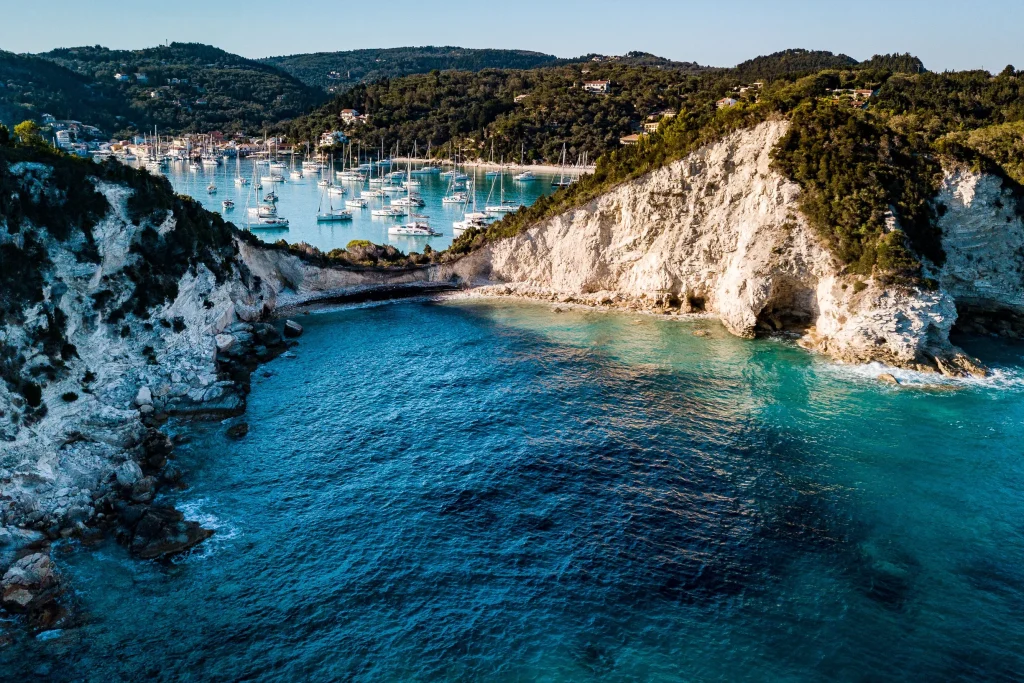
Hydra in the Saronic Gulf, an easy first week out of Athens.
Italy and Spain: a city first, then the boat
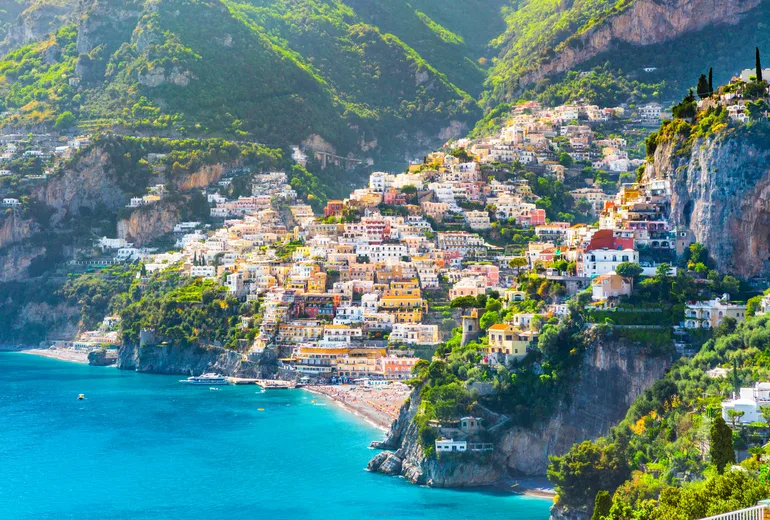
Italy and Spain suit Americans who want a few days of sightseeing before boarding. Rome has many year-round nonstops from US hubs with United, Delta, American and ITA, and Naples has had seasonal nonstops from Newark in recent summers, so check whether that route is on sale for 2027. Bases at Naples, Procida or Salerno put Capri, Ischia, Positano and Amalfi within easy reach. Berths in Capri and Positano are scarce and expensive in peak weeks, which is why many American crews take a local skipper here even when they could legally sail themselves. Expect spaghetti alle vongole, a glass of Fiano di Avellino and limoncello after dinner.
For Spain, fly into Madrid or Barcelona, both typically served nonstop from several US hubs, then take the short hop to Palma de Mallorca. The Balearics are a cove-and-beach destination: Cala d’Or, Porto Colom, the Cabrera national park and, across a day’s sail, Menorca. They are also the priciest of the five, which our article on why the Balearics cost more and when they are worth it explains with numbers. The sea usually stays warm into late September, handy for a trip after Labor Day.
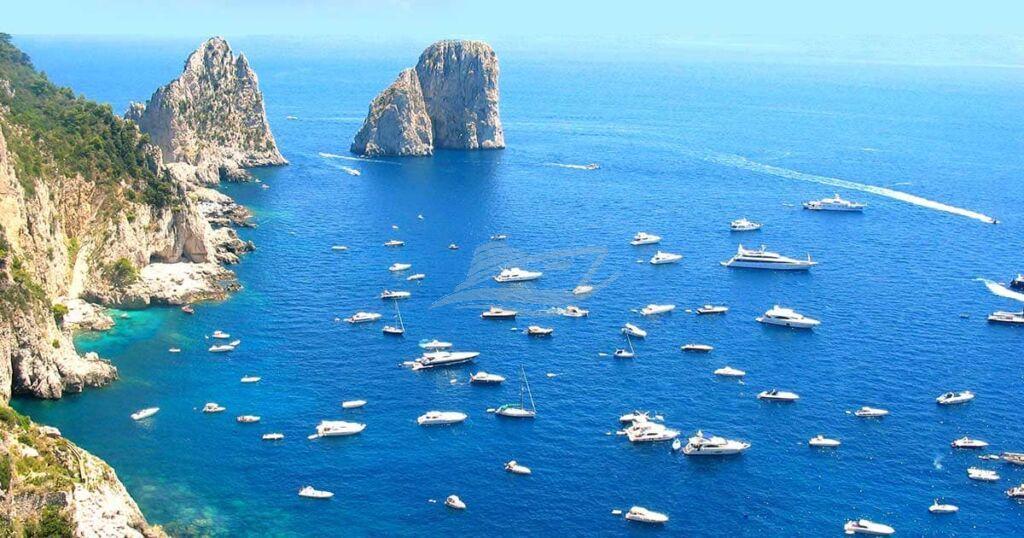
Positano, where scarce summer berths make a local skipper worth the fee.
Türkiye, gulets and the Schengen count
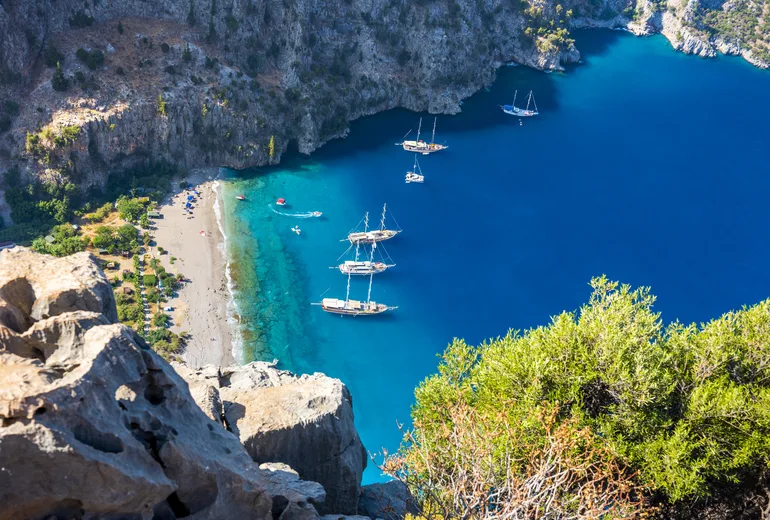
Türkiye sits outside the Schengen area, and its Turquoise Coast between Bodrum, Marmaris, Göcek and Fethiye is home to the gulet, a wooden motorsailer of 20 to 35 meters that carries its own captain, cook and deckhands. There is no such thing as a bareboat gulet; the crew comes with the boat. For eight to twelve guests with nobody holding a certificate, a gulet often gives the most deck space per dollar in the Mediterranean, with meze lunches under the awning and nights in the bays of Göcek’s Twelve Islands.
Entry is the part to check early. Visa rules for US citizens visiting Türkiye have changed more than once, so confirm the current e-visa position on official sources a few weeks before you fly. Flights usually connect through Istanbul. If the group is torn between boat types, our comparison of a gulet or a catamaran in Türkiye sets out crew, comfort and cost.
As for Schengen, a US passport allows up to 90 days in any 180-day period across Croatia, Greece, Italy, Spain and France combined, with no visa. A two-week vacation barely dents that. Keep your passport valid at least three months beyond your planned exit (many advisers say six). Since April 2026 the EU’s Entry/Exit System takes fingerprints and a facial image at first entry, so allow extra time at arrivals. ETIAS is not required yet and is expected in 2027 at the earliest; check the EU’s official ETIAS site before you fly.
Gulets at Butterfly Valley on Türkiye's Turquoise Coast, outside the Schengen count.
Sail, motor or crewed for a 10 to 14 day vacation
Most American crews have ten to fourteen days including two travel days. That fits one seven-night charter with two or three nights on land at either end, and most bases run weekly, so longer charters are possible but less common. The three ways to do it:
Bareboat sailing yacht or catamaran: you skipper, you cook or eat ashore, and the route is decided each morning over coffee. Best value, and a catamaran gives six to eight people more space and far less heel than a monohull.
Skippered: the same boat with a local skipper for about €1,400 to €1,750 a week (roughly $1,600 to $2,100) plus the skipper’s meals. Your crew still helms and trims; the skipper handles stern-to berthing and knows which konoba or taverna holds a mooring for diners.
Fully crewed: a crewed catamaran, gulet or motor yacht with a captain, a chef and a hostess or deckhand. It costs more, but the week turns into a holiday rather than a passage.
Motor yachts cover more water in a day, which suits a short trip such as Split to Vis and back via Hvar, but fuel adds up quickly at cruising speed. Our decision tree for bareboat, skippered, crewed or cabin charter walks through the choice for summer 2027.
Your US certificate in three different systems
There is no single European rule for American paperwork. Each country runs its own system, and the three biggest charter countries handle US certificates in three different ways.
Croatia: an official list
Croatia’s maritime ministry publishes a table of recognised foreign certificates. ASA 104 Bareboat Cruising and US Sailing Bareboat Cruising cover bareboat yachts up to 18 meters in Croatian waters, which takes in every charter catamaran up to about 59 feet. ASA Advanced Coastal Cruising or US Sailing Coastal Passagemaking raise the limit to 24 meters, and the ASA or US Sailing International Proficiency Certificate (IPC) goes up to 500 gross tonnes. Basic Keelboat and Basic Coastal Cruising only cover boats within 6 nautical miles of the coast, so they will not get you a charter yacht, and a state boater education card is not on the list at all. You also need a VHF radio certificate, national or foreign.
Greece: the port police
In Greece the port police check the skipper’s certificate and expect a second crew member to sign a declaration of competence or hold a certificate too. Most charter companies accept ASA 104, but some sources say the port police no longer accept non-European certificates on their own, so the safe move is to carry the IPC or an ICC as well.
Italy: the charter company decides
Italian law lets foreign visitors skipper on their home qualification where one is required at home, and in practice the charter company and its insurer make the call. An ASA 104, IPC or ICC plus a short sailing résumé is what they typically want. For Spain and Türkiye, operators generally expect an ICC or equivalent and a VHF certificate; get the acceptance in writing before you pay.
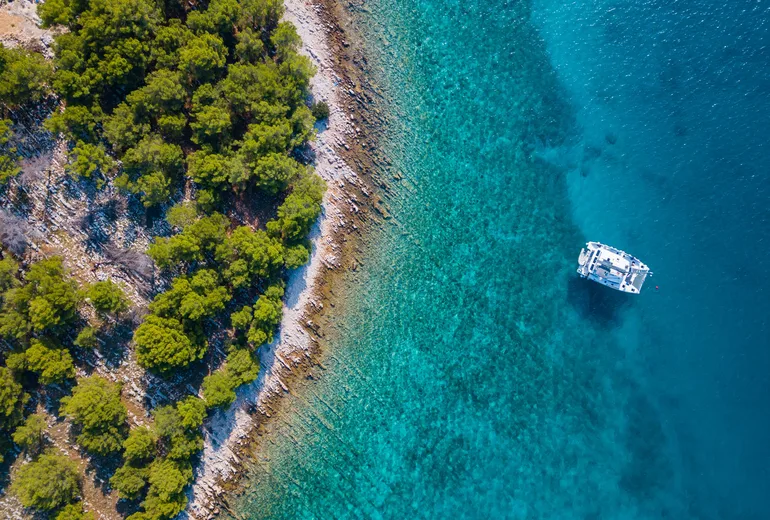
A bareboat catamaran at anchor in Croatia, where ASA 104 covers yachts up to 18 meters.
What each yacht type costs in dollars
Charter prices on our site are quoted in euros, and the euro figure is the contract price. The dollar amounts below use about $1.15 to $1.20 to the euro as of early November 2026, and the rate will move. Typical weekly prices for the boat:
Sailing monohull, 40 to 46 feet, bareboat: €2,000 to €4,500 in June or September ($2,300 to $5,400); €3,500 to €7,000 in July and August ($4,000 to $8,400).
Catamaran, 40 to 42 feet, bareboat: €3,100 to €7,500 in shoulder weeks ($3,600 to $9,000); €6,000 to €11,800 in peak ($6,900 to $14,200).
Crewed catamaran or gulet: roughly €15,000 to €45,000 a week ($17,000 to $54,000), depending on size, season and what the package covers. Turkish gulets usually sit at the lower end.
Motor yacht: about €12,000 to €25,000 for a 15 to 18 meter boat with skipper ($13,800 to $30,000), and €35,000 to €70,000 or more for a fully crewed 25 meter yacht in peak ($40,000 to $84,000), plus fuel.
On a bareboat, set aside another €1,200 to €2,000 ($1,400 to $2,400) for a crew of eight to cover fuel, marinas, provisioning and tourist tax, plus a security deposit of €2,500 to €5,000 or deposit insurance of €150 to €300. Crew tips on a crewed yacht typically run 5 to 15 percent of the charter fee, handed over at the end of the week. For side-by-side figures see our 2027 price comparison for Türkiye, Greece and Croatia. Croatia and Türkiye usually give the most boat per dollar; Italy and the Balearics the least.
Book July and August boats nine to twelve months out, which for summer 2027 means this winter. June and September usually allow six to nine months, though four-cabin catamarans go first in every country.
Frequently Asked Questions
Which European country is easiest for a first yacht charter from the US?
For an East Coast crew with a bareboat certificate, Croatia is usually the easiest, thanks to the United nonstops to Split and Dubrovnik in summer 2026 and short, sheltered hops between islands. For a crew without a certificate, a skippered week in the Ionian or a crewed gulet in Türkiye is often simpler.
Is my ASA 104 enough to charter a bareboat in Europe?
In Croatia it is officially recognised for yachts up to 18 meters, together with a VHF certificate. In Greece many charter companies accept it, but carrying an IPC or ICC avoids problems with the port police. In Italy, Spain and Türkiye the charter company decides, usually with a sailing résumé.
Do Americans need a visa or ETIAS for a charter in Europe in 2027?
No visa is needed for stays of up to 90 days in 180 across the Schengen area. ETIAS is not in force yet and is expected in 2027 at the earliest, so check the official EU site before you travel. Türkiye is outside Schengen and its rules for US citizens should be checked separately.
How much does a week on a yacht in Europe cost in US dollars?
A 40 to 42 foot bareboat catamaran typically runs about $3,600 to $9,000 in June or September and $6,900 to $14,200 in July and August, before running costs. Crewed catamarans and gulets start around $17,000 a week. Prices are contracted in euros, so the dollar figure moves with the exchange rate.
You can read more about how we protect your personal data and use cookies in our Privacy Policy.
With your consent, we and Google use cookies and similar technologies to store and access information on your device and to process personal data such as your visit to this website, your IP address and cookie identifiers. You can withdraw your consent at any time through “Cookies Settings” at the bottom of every page.
We and Google process data for:
Website analytics and visit statistics, recordings of visits to improve the website, ad measurement and remarketing, storing and accessing information on your device



 Charter Tips